Plastic recycling machines by Jiangsu PURUI
Washing lines, pelletizing lines and auxiliary machines manufactured by Purui Machinery in Jiangsu, China, since 2006. Each line is configured for how dirty your material is and what you will make from the pellets.
Washing lines
Torqplas supplies complete washing lines for plastic recycling, as well as individual machines when a plant only needs to add or upgrade one stage. Before pelletizing, plastic waste needs to be size-reduced, washed and, where necessary, separated from foreign materials. Each line is configured according to the material, how dirty it is, and the flake quality required.
Typical materials include:
- industrial, agricultural and post-consumer PE/PP film, including thin film, stretch film and packing film
- PP woven bags
- PET bottles
- HDPE/PP bottles and containers, such as milk, detergent and shampoo bottles
- rigid parts such as drums, crates and containers
- PP/ABS housings from dismantled lead-acid battery cases
Depending on the application, a washing line may include a shredder or crusher, metal separator, friction washer, intensive or hot washer, sink-float tank, mechanical dryer or squeezer, thermal dryer, label and material separators, screening, conveying equipment, and the electrical control system. Stations can be added or removed to match the feedstock.
The result is clean, dry flakes or squeezed material, ready for pelletizing or for sale as washed flakes.
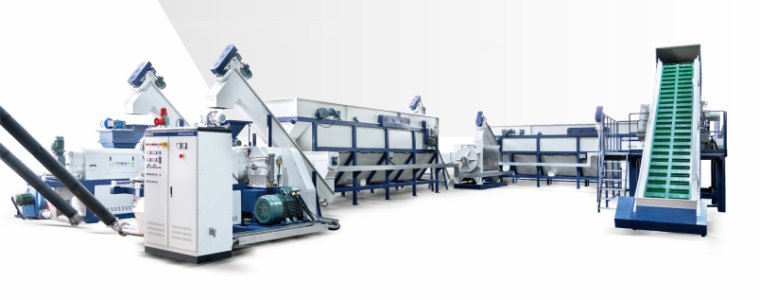
PE/PP film washing line
Mainly for agricultural film and greenhouse film, post-consumer packaging film and woven bags. Output 500 to 2,000 kg/h. The washing steps are designed around how dirty your material is: how much sand and soil it carries, other impurities, labels and so on. Please send photos of your film or bales before we quote.
PP woven bag washing line
For PP woven bags, raffia bags and jumbo bags, including heavily soiled bags. Pre-shredding and repeated pre-washing remove sand and soil before the friction washer.
| Capacity (kg/h) | 500 | 800 | 1,000 | 1,500 | 2,000 |
|---|---|---|---|---|---|
| Moisture after squeeze dryer | 1 – 3 % | ||||
| Water consumption, standard line | 15 – 20 t/h | ||||
| Recommended water treatment system | 25 m³/h | ||||
Washing line layout, step by step
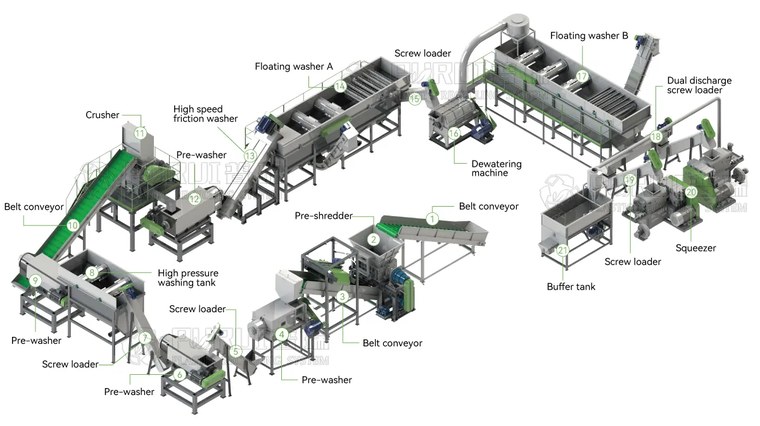
- Belt conveyor
- Pre-shredder
- Belt conveyor
- Pre-washer
- Screw loader
- Pre-washer
- Screw loader
- High-pressure washing tank
- Pre-washer
- Belt conveyor
- Wet crusher
- Pre-washer
- High-speed friction washer
- Floating washer A
- Screw loader
- Dewatering machine
- Floating washer B
- Dual-discharge screw loader
- Screw loader
- Squeeze dryer (squeezer)
- Buffer tank
Pre-shredding and repeated pre-washing (stations 2 to 12) take out sand and soil before the friction washer. For cleaner material, some of these stations are left out: the steps are chosen by how dirty your material is.
PET bottle washing line
For post-consumer PET bottles, from bales to clean, dry flakes. The configuration is set by two questions: what the flakes will be used for, and how dirty the bottles are. Bottle-to-bottle feedstock needs deeper sorting and a batch hot wash; flakes for staple fiber or strapping can run on a simpler line. Lines are built with input capacities from 1,000 to 7,000 kg/h. The data below is for the 2,000 kg/h reference line. The flake yield depends on caps, labels, moisture and dirt in your bales.
Process: bale opening → trommel screen → metal removal → dry label remover → whole-bottle pre-wash → NIR and manual sorting → wet crushing → float-sink → hot wash at 80–90 °C with caustic soda → friction washing and rinsing → centrifugal and thermal drying → zig-zag label separation → flake sorting → big-bag packing.
| Item | Bottle-grade configuration | Standard hot-wash configuration |
|---|---|---|
| Typical end use | Feedstock for bottle-to-bottle (after decontamination), clear food-contact sheet | Filament, staple fiber, strapping, non-food sheet |
| Hot wash | Hot pre-wash of whole bottles + batch hot wash with 30 m³ buffer silo | Continuous hot wash, 2 hot washers in series |
| Flake sorting | Material sorter + colour sorter | Colour sorter |
| Moisture | ≤ 0.9 % | ≤ 0.9 % |
| Total impurities | ≤ 80 ppm | ≤ 100 ppm |
| PVC | ≤ 50 ppm | ≤ 70 ppm |
| PE/PP | ≤ 10 ppm | ≤ 10 ppm |
| Glue | ≤ 5 ppm | ≤ 10 ppm |
| Metal / paper / organics | ≤ 10 / ≤ 5 / ≤ 10 ppm | |
| Label residue | ≤ 20 ppm | |
| Off-colour flakes | ≤ 30 ppm | |
| pH after rinsing | neutral | |
| Flake size / bulk density | 12–14 mm / about 0.3 g/cm³ | |
| Installed power (actual draw about 80 %) | about 830 kW | about 620 kW |
| Water | 8 m³/h, 0.4 MPa | 6 m³/h, counter-current reuse |
| Steam (170 °C, 0.7 MPa) | 800 kg/h | 500 kg/h |
| Operators | 10 per shift | |
The washing line produces bottle-grade flakes. Food-contact rPET also needs a certified decontamination step downstream, approved in the target market (in Brazil, ANVISA). Whole-bottle NIR sorter, water treatment and steam boiler are quoted separately. The manufacturer of the PET washing line is named in the quotation. How to configure a PET washing line.
PE/PP bottle washing line
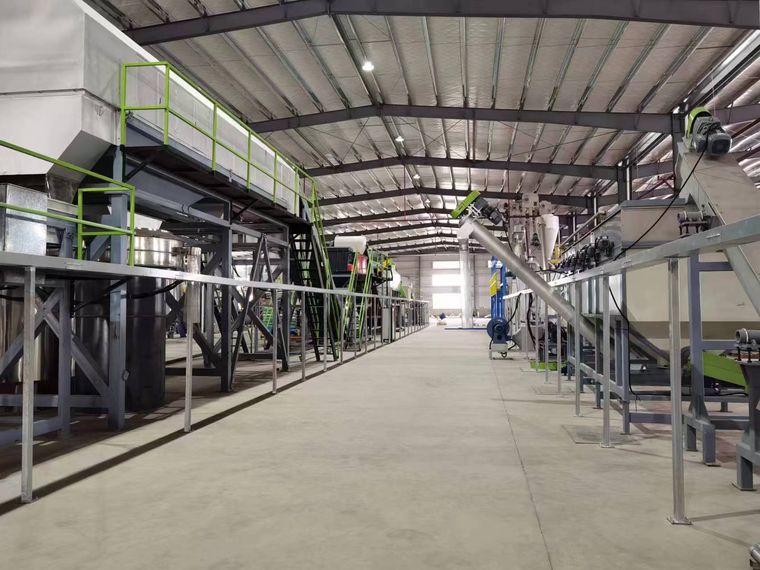
For post-consumer HDPE and PP bottles such as milk, detergent and shampoo bottles. The standard line is crushing, hot washing and drying; sorting, colour sorting and bagging are added only when the customer needs them. Dry pre-cleaning takes out stones, sand and metal before the bottles reach the crushers, which protects the knives and keeps the water cleaner.
Process: chain-plate feeding → four-shaft bale breaker → magnetic separator → trommel screen → pre-washer → manual sorting and 10 m³ buffer silo → 3 wet crushers in parallel → friction washing → 2 hot wash stages with high-speed friction washers → 4 rinsing and friction stages → horizontal dewatering → centrifugal dryer → pneumatic drying with 2 label separators.
| Item | Value |
|---|---|
| Raw material | Post-consumer HDPE/PP bottles (milk, detergent, shampoo), baled or loose |
| Flakes | 10–14 mm |
| Moisture | about 1 % after pneumatic drying and label separation |
| Bulk density | about 300 kg/m³ (0.3 g/cm³) for milk and detergent bottle flakes; depends on the source |
| Hot wash | 2 stages, about 6 m³ each, 70–80 °C, automatic caustic dosing |
| Installed power | about 1,000 kW class at 4,000 kg/h, final figure by configuration |
| Water | 15 t/h, 0.4 MPa, closed-loop filtration with make-up |
| Steam (hot wash) | 1,000 kg/h, 170 °C, 0.7 MPa; steam boiler optional |
| Workshop (minimum) | 90 m × 20 m × 6 m, with overhead crane |
| Operators | 7–9 per shift |
| Optional equipment | Steam boiler, colour sorter, automatic bagging |
HDPE and PP both float, so the rinsing tanks cannot separate them: that needs an NIR sorter. PET bottles need the PET line above. Washed flakes can go straight to an SJ pelletizing line. How a PE/PP bottle washing line is configured.
Battery case PP/ABS washing and separation line
For the plastic housings of dismantled lead-acid batteries: PP and ABS, with small amounts of metal and lead residue. The line washes both polymers and separates them by density, so recyclers get clean PP flakes and clean ABS flakes from the same plant.
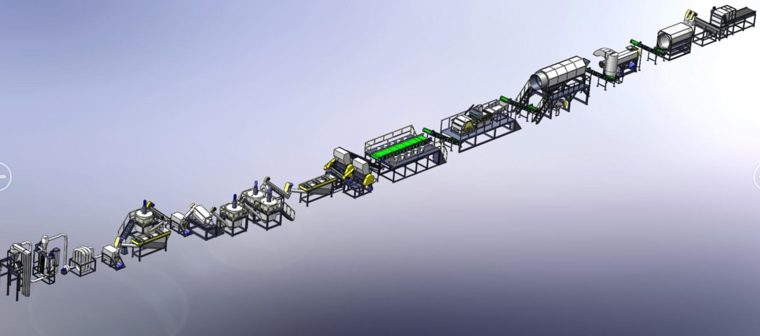
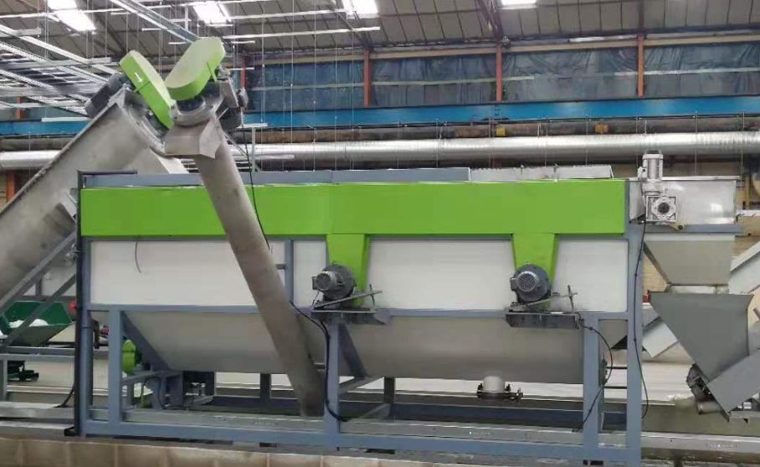
How the separation works: PP and ABS run in separate batches. For ABS, the sink-float separator runs with brine at a density of about 1.08, so ABS floats while metal, lead residue and heavier plastics sink. For PP, the same separator runs with clean water. After crushing and friction washing, a second washing and separation tank splits PP (floats) from ABS (sinks) again. The flakes are dewatered, dried in a hot-air tower dryer, de-labelled, screened and colour-sorted.
| Item | Value |
|---|---|
| Capacity (input) | Approx. 1,500 kg/h of battery case plastic, pre-crushed to approx. 80–100 mm |
| Output | Clean PP or ABS flakes; the yield depends on the metal, lead paste and dirt content of your material |
| Crusher | 110 kW, rotor Ø700 × 1,200 mm; screen 22 mm for ABS, 18 mm for PP |
| Washing | High-speed friction washer 45 kW, screw friction washer 18.5 kW, separation tank 8 m |
| Drying | Horizontal dewatering machine 37 kW, hot-air tower dryer 42 kW, zig-zag label separator |
| Installed power | Approx. 350 kW (actual consumption about 80 %) |
| Water | Approx. 4 t/h at 0.4 MPa, water treatment recommended |
| Workshop | 40 × 20 × 5 m |
| Operators | 4–5 per shift |
| Options | Colour sorters (need compressed air) |
Parts in contact with water and material are stainless steel (304 or 316L). The manufacturer of this line is named in the quotation. Washed PP and ABS flakes can be pelletized on a two-stage SJ line.
Pelletizing lines
Film pelletizing: ML series
For clean, dry BOPP, PP, HDPE, LDPE, LLDPE, PS, PLA and PET film scrap, non-woven fabric, woven bags and fibre, fed without washing. Washed film flakes from a washing line go to an SJ two-stage line instead (see below). Output below is per material; the actual figure depends on bulk density, moisture and contamination.
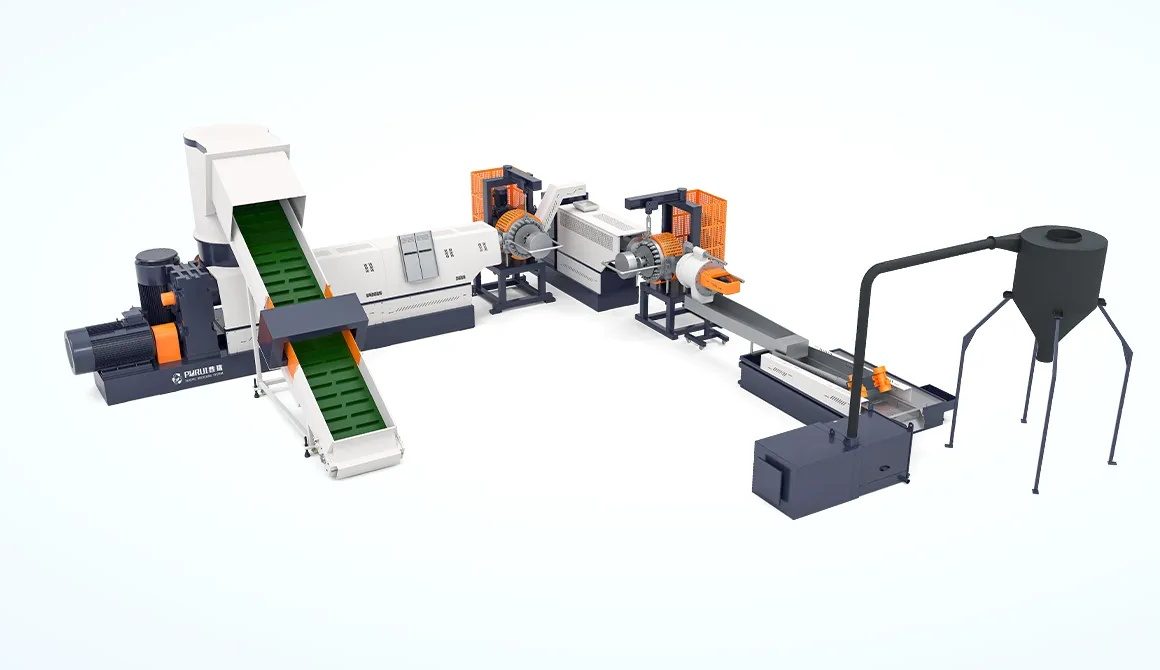
| Model | Screw diameter | PP (kg/h) | HDPE (kg/h) | LDPE (kg/h) |
|---|---|---|---|---|
| ML75 | 75 mm | 100 | 120 | 150 |
| ML85 | 85 mm | 120 | 150 | 180 |
| ML100 | 100 mm | 200 | 300 | 400 |
| ML130 | 130 mm | 400 | 500 | 600 |
| ML160 | 160 mm | 600 | 700 | 1,000 |
| ML180 | 180 mm | 800 | 1,000 | 1,200 |
New build: shredder-fed ML100 line with laser filter and vertical water-ring pelletizer
Just finished at the Jiangsu PURUI factory for a film recycler in Tunisia. Thick or rolled film goes through a single-shaft shredder before the compactor/agglomerator, so the line takes material that would bridge or wrap in a compactor alone. Side feeders add rigid regrind and colour masterbatch. A self-cleaning laser filter on the first stage handles printed and dirtier film; a hydraulic screen changer on the second stage gives the final filtration before a vertical water-ring pelletizer. Output: about 200 kg/h for PP, 300 kg/h for HDPE and 400 kg/h for LDPE film; for heavily contaminated film see the screen changer and laser filter guide.
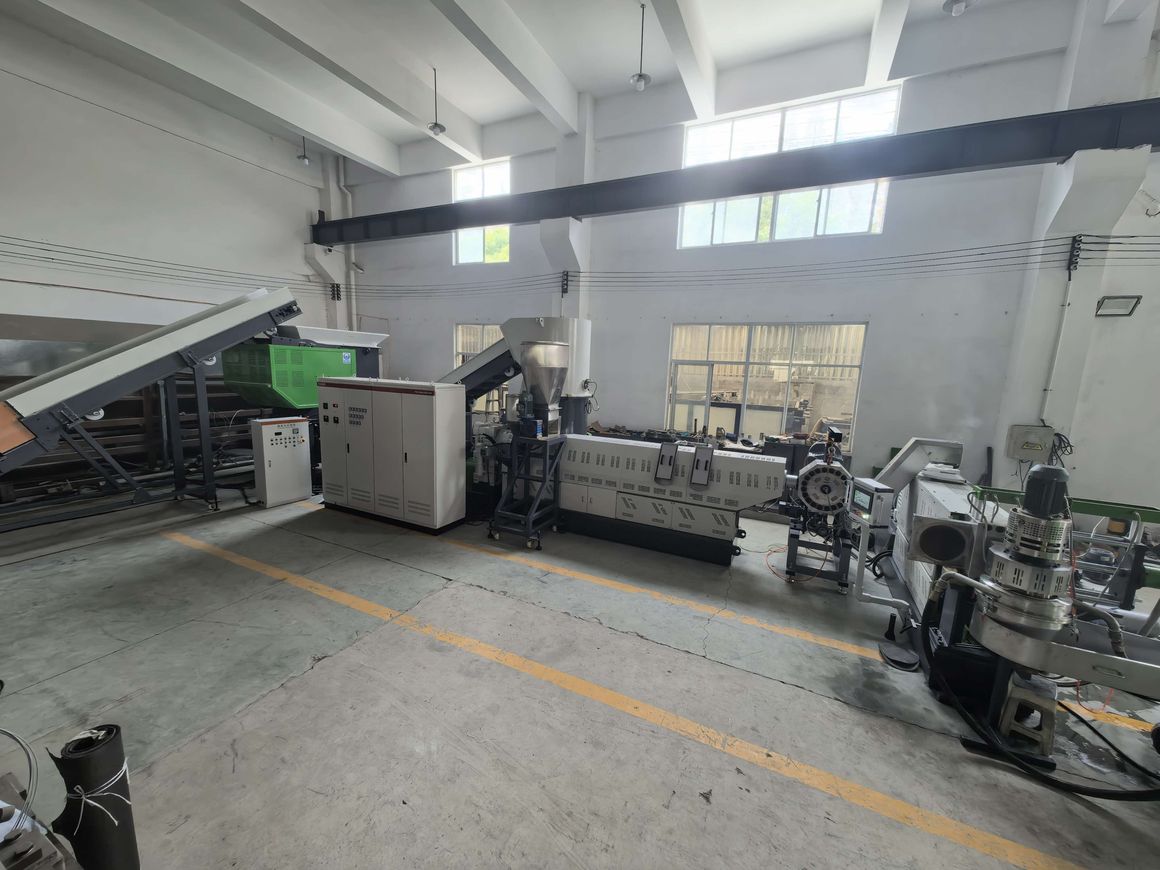
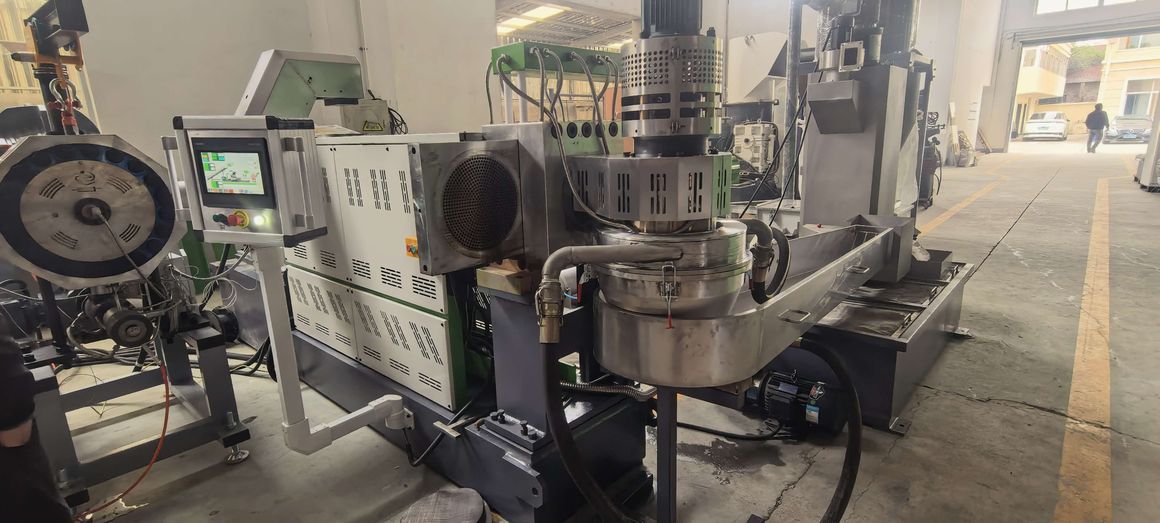
| Output | PP approx. 200 kg/h · HDPE approx. 300 kg/h · LDPE approx. 400 kg/h |
| Feeding | Belt conveyor (PVC belt, 600 mm, 1.5 kW) → single-shaft shredder → belt conveyor with metal detector → compactor/agglomerator |
| Single-shaft shredder | 850 mm shaft, 55 kW, 74 r/min; 70 rotary + 6 fixed D2 blades, screw-type blade layout so thin film does not wrap the rotor; zig-zag screen; 500–800 kg/h of PP/PE film; own control box with Siemens PLC |
| Metal detector | Stops the belt when it detects metal larger than about 6–8 mm |
| Compactor/agglomerator | 55 kW, Schneider soft start; 12 stationary + 6 rotary cutters; stainless steel in contact with material; water-cooled bottom bearing; gate valve to meter material into the extruder |
| Side feeders | Silo feeder for rigid regrind (0.4 m³, 3 kW) and additive / colour masterbatch feeder (1.1 kW), both stainless steel in contact with material |
| First-stage extruder | Ø100 mm, L/D 33:1, 90 kW; 38CrMoAlA nitrided screw and barrel; air-cooled barrel; double vacuum degassing; high-torque gearbox with forced lubrication |
| First-stage filtration | Self-cleaning laser filter, Ø400 mm, two plates with two scrapers, up to 25 MPa; 40 to 100 mesh |
| Second-stage extruder | Ø120 mm, L/D 12:1, 30 kW |
| Second-stage filtration | Double-station hydraulic screen changer, Ø300 mm, screen change in 2 s or less without stopping |
| Pelletizing | Vertical water-ring die-face pelletizer, 2.2 kW frequency-controlled cutter; water pump 3 kW |
| Drying and storage | Centrifugal dewatering (3 kW, stainless steel, separate water tank) → pneumatic conveying (3 kW) to a 1 m³ stainless silo; pellet moisture 1–2 % |
| Controls | Siemens PLC with touch screen for the whole line; ABB inverters for feeder, extruder and pelletizer; melt pressure display and protection |
Rigid plastic pelletizing: SJ series
For washed film flakes, HDPE bottle flakes, crushed rigid PE and PP, and PP, PC and ABS regrind: buckets, small hollow bottles, milk bottles and other rigid material. Available as single-stage or two-stage lines. Filtration options are covered in the screen changer guide.
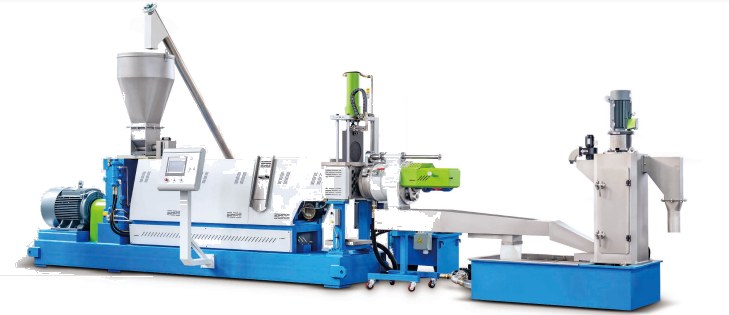
| Model | SJ100 | SJ120 | SJ140 | SJ150 | SJ160 | SJ180 | SJ200 |
|---|---|---|---|---|---|---|---|
| Screw diameter (mm) | 100 | 120 | 140 | 150 | 160 | 180 | 200 |
| L/D | 18 – 42 | ||||||
| Screw speed (r/min) | 10 – 150 | ||||||
| Output (kg/h) | 250–350 | 300–400 | 500–600 | 600–800 | 800–1,000 | 900–1,200 | 1,000–1,500 |
Squeezed film and woven bags: SJ two-stage line
Washed film and woven bags leave the washing line through a squeezer as dense, low-moisture lumps. Squeezed material is conveyed by air into a storage silo and fed to the pelletizing line automatically, so the line runs without manual feeding. Any shape of squeezed material is accepted.
| Model | Output (kg/h) |
|---|---|
| SJ140/150 | 500 |
| SJ160/180 | 800 |
| SJ180/200 | 1,000 |
| SJ200/220 | 1,200–1,400 |
PET bottle flakes pelletizing: SJ series with pre-drying
PET absorbs moisture from the air. If damp flakes go straight into a hot barrel, the water breaks the polymer chains (hydrolysis) and the intrinsic viscosity (IV) drops. Low-IV pellets are hard to sell into demanding uses such as filament spinning or bottle-grade resin. This line dries the flakes before they reach the extruder and melts them gently, so the pellets keep their IV.
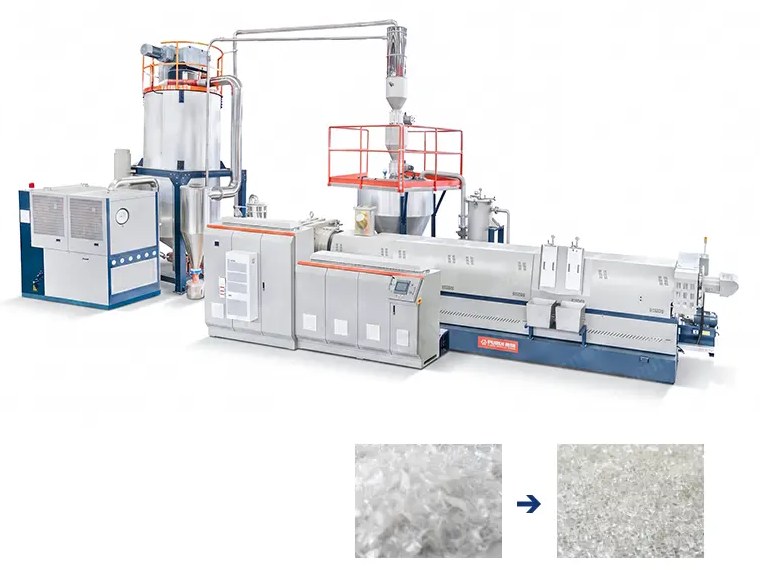
| Screw diameter | 160 mm |
| Main motor | 200 kW |
| Output | 800 – 1,000 kg/h |
| Input material | Washed post-consumer PET bottle flakes, moisture ≤ 1.0 % |
| IV loss, flakes to pellets | < 0.04 dL/g |
Two ways to prepare the flakes. Both PET flakes lines are single-stage.
- SJ series: hot dehumidified-air pre-drying and crystallization in front of the extruder, as described above. After pre-drying, the flakes go to a single-screw extruder or, if the pellets need compounding, to a VJJ twin-screw extruder.
- CT series: a compactor/agglomerator with a rotating and a stationary knife disc mixes the flakes and dries them with friction heat, then feeds the single-screw extruder. Vacuum degassing on the extruder removes the remaining moisture and volatiles to limit the IV drop.
| Model | Output (kg/h) |
|---|---|
| CT110 | 500–600 |
| CT130 | 800–900 |
| CT160 | 1,000–1,500 |
| CT180 | 1,800–2,000 |
How the line protects IV
- Hot dehumidified-air pre-drying. A drying hopper sits directly above the extruder inlet. Hot, dry air passes through the flakes continuously, so the moisture is removed before they reach the feed throat. No vacuum drying system is needed.
- First-in, first-out hopper. In many drying hoppers the material runs down the centre while older flakes hang on the walls, so drying time varies. This hopper is shaped for true first-in, first-out flow: every flake gets the same time and heat, moisture is even at the feed throat, and motor load stays stable.
- Screw designed for gentle melting. The screw profile keeps shear and heat low. Together with the pre-drying, IV loss is held below 0.04 dL/g.
The less IV you lose in pelletizing, the less virgin resin you need to blend in downstream.
PET line FAQ
What material is the SJ PET flakes pelletizing line designed for?
Washed, cleaned and sorted post-consumer PET bottle flakes.
How does the pre-drying prevent PET degradation?
Hot dehumidified air passes continuously through the flakes in a single drying stage and removes the moisture before extrusion. Without that moisture, the resin does not hydrolyse when it melts.
What is the maximum moisture of the incoming flakes?
The line is designed for flakes with an initial moisture content of 1.0 % or less.
Why does first-in, first-out flow in the drying hopper matter?
Every flake stays in the hopper for the same time, so the whole batch is dried evenly and the extruder sees constant moisture.
How much IV is lost from flakes to pellets?
Less than 0.04 dL/g, thanks to controlled drying and a screw designed for gentle melting.
For a quotation, send: the IV and moisture of your flakes, main contaminants (PVC, labels, glue, metal), target output and what the pellets will be used for.
PET and BOPET film pelletizing: DC series
For PET and BOPET film scrap. A compactor/agglomerator with knife discs dries the film by strong friction heat and feeds the extruder automatically. Strand pelletizing cuts the strands without manual pulling, two groups of temperature monitoring guard the process, and a Siemens PLC controls the line. The pellets are used for sheet and profile production.
| Model | Output (kg/h) |
|---|---|
| DC100 | 400 |
| DC120 | 600 |
| DC140 | 1,200 |
| DC160 | 1,600 |
| DC180 | 2,000 |
Recycling and modification line: single screw + twin screw
A two-in-one line for recycling and compounding in one pass. The single-screw first stage melts and filters the recycled material; the melt then goes straight into the twin-screw second stage, where fillers, glass fibre, pigments or additives are added. The result is modified recycled pellets that can be used far more widely than plain regrind.
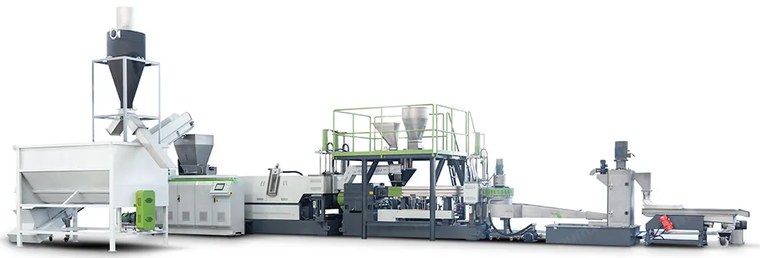
| First stage | Single-screw extruder, screw diameter 110 mm, motor 132 kW |
| Second stage | Twin-screw extruder, screw diameter 75 mm |
| Line output | 600 kg/h |
| Power configuration | Set according to the material and formula |
Typical applications:
- Filling: PE/EVA + calcium carbonate, talc, TiO2, carbon black
- Glass fibre or carbon fibre reinforcement: PP, PA, PBT, ABS, PC, POM, PET
- Colour and black masterbatch: PE, PP, ABS, PS, EVA, PET + pigment
- Flame-retardant compounds and masterbatch: PP, PA, ABS, PBT, EVA
- Alloys: PC/ABS, PA/ABS, PP/EPDM, PP/SBS
- Biodegradable compounds: PE, PLA, PBAT + starch and additives
- Cable compounds: PVC, PE, low-smoke halogen-free
- Thermoplastic elastomers: TPU, TPE
The HDPE milk bottle project below ran on this line configuration.
Case study: food-grade HDPE milk bottle flakes
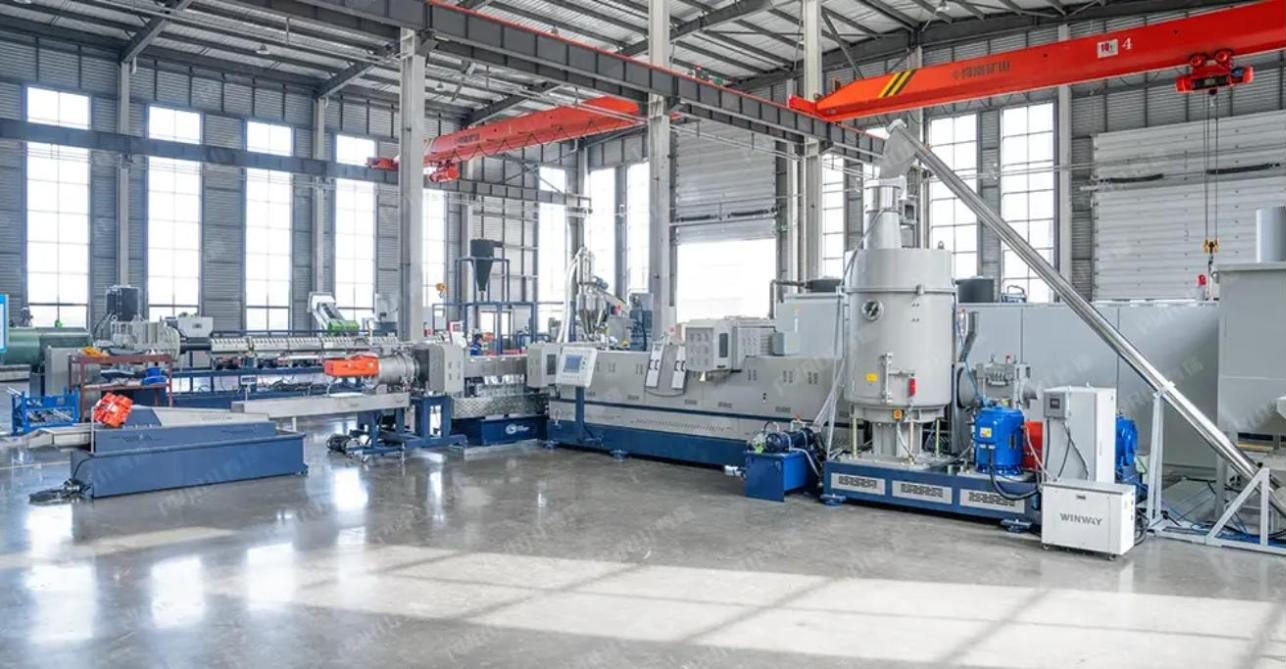
Material: post-industrial and post-consumer HDPE milk bottles, supplied as pre-washed flakes.
Goal: white or ivory pellets with a stable melt flow index, clean enough to go back into blow-moulded bottles.
The challenge
- Odour. Residual milk protein turns sour in the melt unless it is degassed properly.
- Colour. Any burning or black spots ruin the value of white HDPE.
- Melt flow. The pellets must keep a consistent MFI to run again on blow-moulding machines.
How the line was configured
- Forced side feeding. Light, irregular milk-bottle flakes bridge in a plain hopper. A side feeder keeps a constant, pressurised flow into the first extruder.
- Low-shear screw. The screw profile avoids over-heating the HDPE, which protects chain length and keeps the colour white instead of yellow.
- Two-stage filtration. The first stage removes coarse contamination; the second stage uses a hydraulic screen changer down to 80–100 μm.
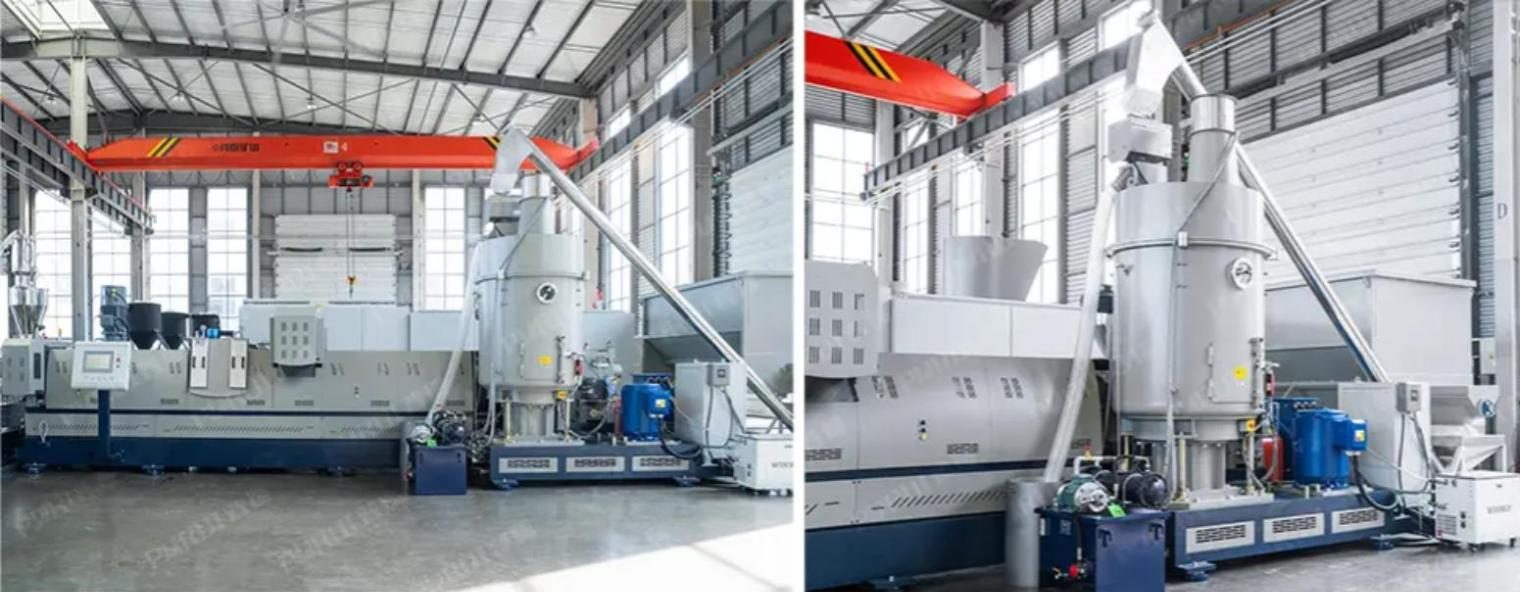
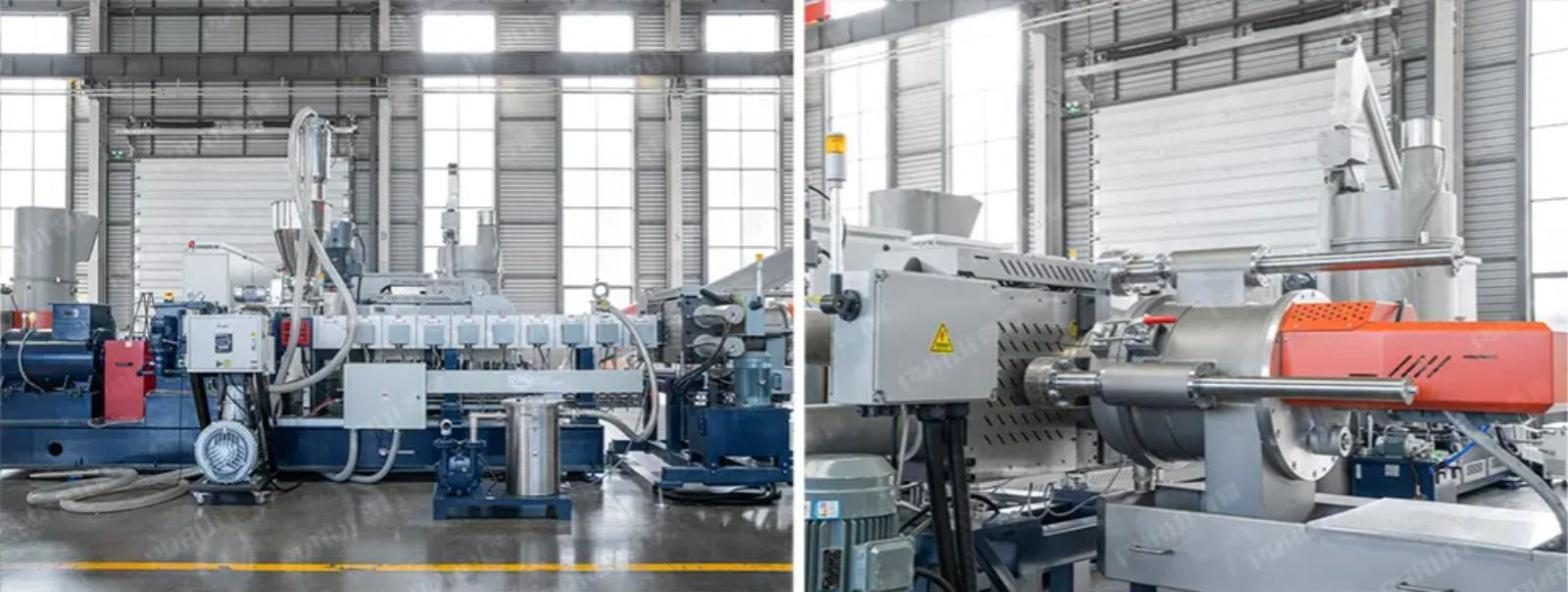
Results reported by Jiangsu PURUI
- The pellets passed the customer's sensory test for residual odour.
- No black spots, after dead zones in the die head were removed.
- The customer replaced 30% of its virgin HDPE with the recycled pellets.
Auxiliary machines
Double-shaft shredder: XD-E series
See model-by-model specifications and send a shredder inquiry.
Breaks bulky plastic waste such as film rolls, woven bag bales, crates, drums, pipes and pallets into pieces before washing or pelletizing. The same machine also handles wood, rubber, e-waste and packaging drums. Output is 500 to 1,500 kg/h, depending on the material.
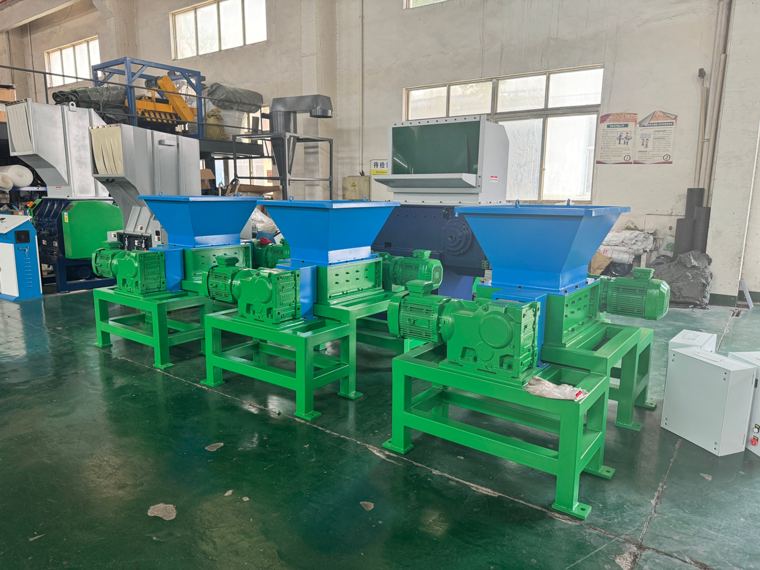
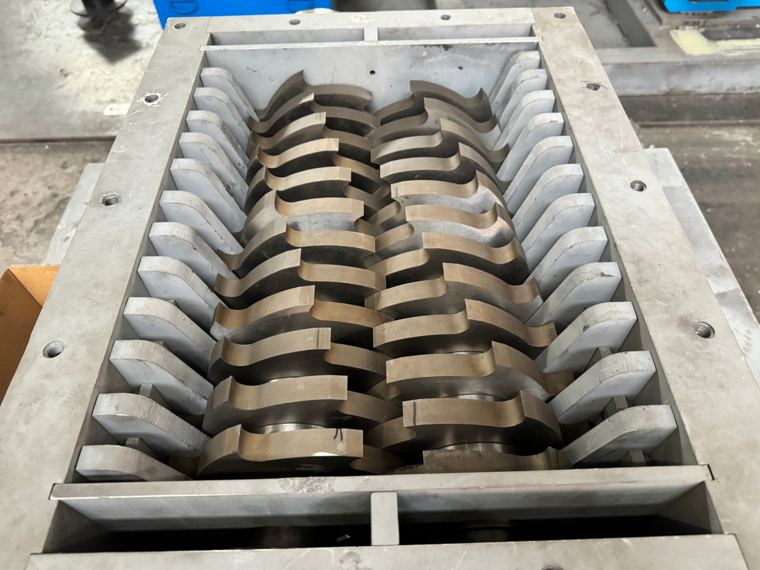
- Low speed, high torque, low noise. Tough and bulky material is torn rather than cut at high speed.
- PLC control. Automatic start and stop, reverse, and automatic reverse on overload to clear jams.
- Blades for your material. One, two, four or more claws per blade, 10 to 80 mm thick, mounted as a fixed set or individually replaceable.
| Series | XD-E double-shaft shredder |
| Output | 500 – 1,500 kg/h |
| Blade thickness | 10 – 80 mm |
| Control | PLC, auto-reverse on overload |
Single-shaft shredder: models 600 to 1500
Compare documented 600, 800 and 1000 model data and request selection.
Breaks plastic lumps, purgings, pipes, profiles, crates and film rolls into pieces before washing or pelletizing. The same machine is also used for wood and biomass, industrial and solid waste, and corrosive waste. Output is 200 to 1,500 kg/h, depending on the model and the material.
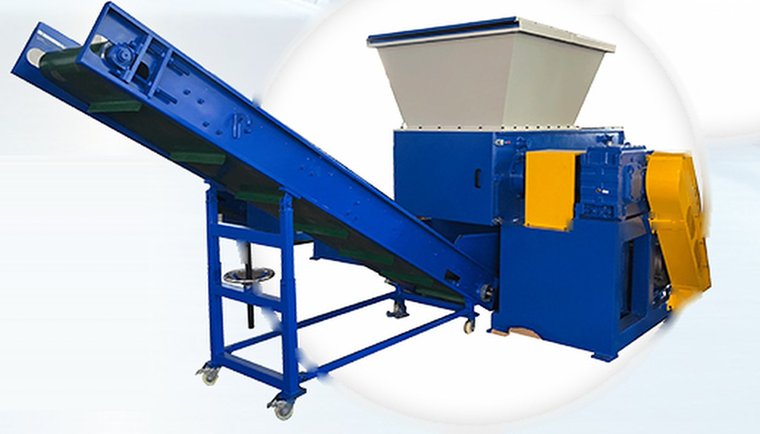
| Type | Single-shaft shredder |
| Models | 600 · 800 · 1000 · 1200 · 1500 |
| Output | 200 – 1,500 kg/h |
Single or double shaft? It depends on the material. Some materials can only be shredded on a single-shaft machine, others only on a double-shaft machine. Send a photo of your material and we will tell you which one fits.
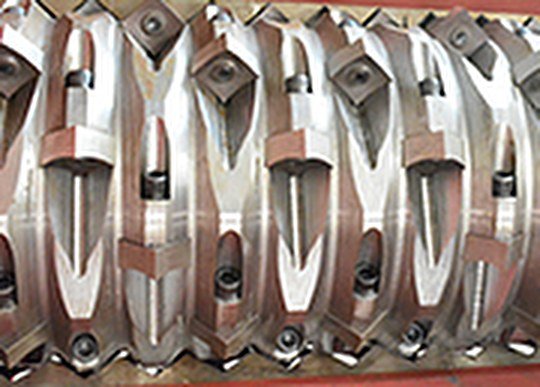
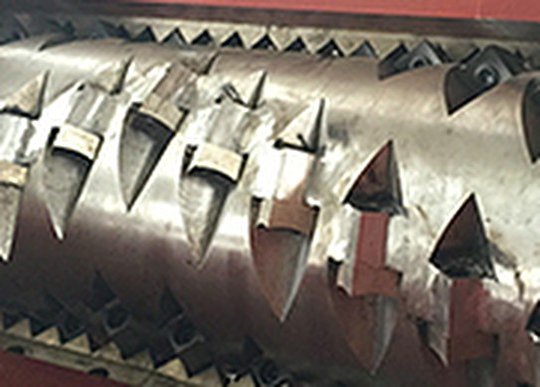
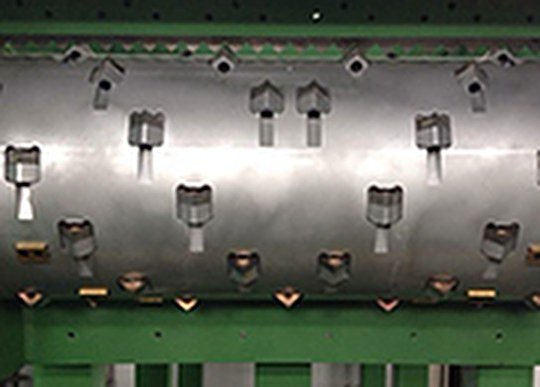
Single-shaft shredder rotors:
Pelletizer
Cuts the extruded strands or melt into uniform pellets at the end of the pelletizing line. The cutting method is matched to the material and output.
Send a sample photo first. A photo of your material, the final use of the pellets and the output you need is enough for a first configuration. Every line is specified to your material, output and plant conditions.
Request a factory quotation
Share your name, contact, material and target capacity. The engineering team will use these details to prepare the quotation.
Tell us your material and target output
Every line is specified to your material, output and plant conditions. These are custom machines, not stock items. Send the material, target kg/h and plant power. We reply within 24 hours with a configuration and a quotation.
- WhatsApp: +86 130 1820 8126
- Email: [email protected]