Calcium Carbonate (CaCO3) Filler Masterbatch Twin Screw Extruder
A configurable compounding line for PE or PP filler masterbatch with up to 85% CaCO3. High-dispersion screw elements, controlled powder feeding and effective venting help maintain stable output. Specify a permanent-magnet synchronous motor for energy-efficient operation. Send your recipe and target output for a factory quotation within 24 hours.
Four process features for high-filled CaCO3 compounds
Final screw layout and line configuration are selected around the carrier resin, CaCO3 grade, coating, target loading and required output.
High-dispersion screw configuration
Kneading and conveying elements are arranged to wet out mineral powder and disperse it through the PE or PP melt. Element sequence is matched to the formulation and shear requirement.
Gravimetric dosing, side feeding and two-stage vacuum venting
Loss-in-weight feeding meters the main ingredients; a side feeder introduces mineral powder into the melt zone. Two vacuum venting stages help remove entrained air and volatiles.
Bimetallic wear-resistant barrel
A wear-resistant bimetallic barrel option is suited to abrasive mineral filler. Material grade and wear protection are specified for the filler and operating conditions.
Air-cooled die-face hot cutting
Rotating knives cut pellets at the die face, followed by air cooling and conveying. This configuration avoids a strand water bath; confirm pellet shape and cooling needs against your formula.
Filler masterbatch line process flow
Typical process sequence; feeder arrangement and downstream equipment are confirmed against the project recipe.
- PE/PP resin and additives
Loss-in-weight dosing - Premixing and main feeding
- CaCO3 side feeding
- Twin-screw melting and dispersion
- Two-stage vacuum venting
- Die-face hot cutting
- Air cooling and pellet collection
TP series model comparison
Model numbers indicate nominal screw diameter. Throughput and motor rating depend on screw design, CaCO3 grade, carrier resin, loading and target pellet quality; request a configuration based on your recipe.
| Model | Nominal screw diameter | Typical configuration | Output selection |
|---|---|---|---|
| TP-52 | 52 mm | Compact compounding; gravimetric main feed + CaCO3 side feeder + two-stage vacuum | Matched to recipe and target kg/h |
| TP-65 | 65 mm | Production compounding; gravimetric main feed + CaCO3 side feeder + two-stage vacuum | Matched to recipe and target kg/h |
| TP-75 | 75 mm | Higher-throughput production configuration; feeding and venting sized to formulation | Matched to recipe and target kg/h |
| TP-95 | 95 mm | Large-capacity production configuration; feeding and venting sized to formulation | Matched to recipe and target kg/h |
The table lists nominal model sizing only. We have not published unsupported motor power or capacity figures for these models; the factory confirms them with the final screw and process configuration.
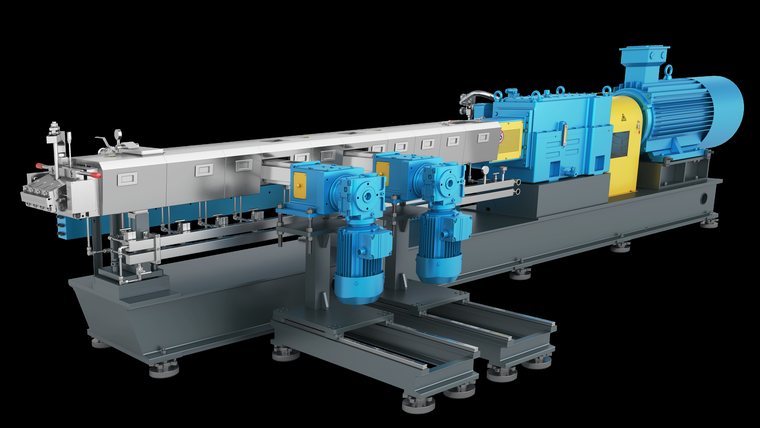
Main specifications
| Item | Range |
|---|---|
| Screw diameter | 8 – 177 mm |
| Output | 20 – 5,000 kg/h, depending on model and formula |
| Specific torque | 11.3 Nm/cm³ standard series; up to 14 Nm/cm³ high-torque series |
| Maximum screw speed | 900 rpm standard; up to 1,200 rpm |
| Barrel length | 24 – 68 L/D, modular |
| Maximum process temperature | ≥ 450 °C |
| Electrical components | Siemens, ABB, Schneider |
| Pelletizing options | Strand, water-ring, underwater, air-cooling die-face cutting (how to choose) |
| Certification | ISO, CE |
What customers run on them
For a buyer’s overview of how recipe, feeding, venting, filtration and pelletizing affect line selection, see our twin-screw application and compounding guide.
Color and additive masterbatch
High shear for pigment dispersion, fast screw changes between colors.
Filler masterbatch
CaCO₃ and talc at high loading. Torque matters most here: it sets how much filler the line can take at full output. Read the guide.
Engineering plastics
PC, PA, PBT with glass fiber, flame retardants and alloys, with side feeders and vacuum venting. For clear PC, read the guide.
Recycled plastics
Upgrading washed PE, PP and PET flakes into compounds, with degassing and melt filtration.
Filler masterbatch extruder FAQs
Can this twin-screw line produce filler masterbatch with 85% CaCO3?
Configurations can be designed for CaCO3 loading up to 85%, subject to the CaCO3 grade and coating, carrier resin, additives, feeding stability and pellet quality target. Share these details so the factory can confirm feasibility and output for your formulation.
Why use gravimetric feeding, a side feeder and two vacuum stages?
Loss-in-weight dosing controls the main ingredients, while the side feeder introduces mineral powder into the melt zone. Two-stage vacuum venting helps remove entrained air and volatiles. Feeder positions and vacuum settings are finalized for the formulation.
Which pelletizing method should I choose for CaCO3 filler masterbatch?
Air-cooled die-face hot cutting is one available option for highly filled compounds; strand, water-ring and underwater systems have different cooling, pellet-shape and operating requirements. Compare strand, water-ring, underwater and air-cooling pelletizing systems before selecting the configuration.
What information is needed for a factory quotation?
Send the carrier resin, CaCO3 percentage and grade, additives, target output in kg/h, pellet specification, local voltage and destination. The factory can then confirm the model, screw configuration, motor, feeders, vacuum system and quotation within 24 hours.
Request a factory quotation
Share your name, contact, material and target capacity. The engineering team will use these details to prepare the quotation.
Tell us your material and target output
Every line is specified to your material, output and plant conditions. These are custom machines, not stock items. Send the material, target kg/h and plant power. We reply within 24 hours with a configuration and a quotation.
- WhatsApp: +86 130 1820 8126
- Email: [email protected]