HDPE and PP bottles look like an easy stream: they float, they are thick, and natural HDPE flakes sell well. The trouble is in the details: milk residue that sours, detergent, PP film labels that float with the flakes, and caps of a different polymer. This guide explains how a PE/PP bottle washing line is built, which modules are standard and which are optional, and what to ask when you compare quotations.
Standard line and optional modules
The standard line is crushing, hot washing and drying. Sorting, colour sorting and bagging are added only when your customers pay for them. If you only need clean flakes without visible contamination, a colour sorter adds price and complexity without adding value.
| Level | For whom | What it includes |
|---|---|---|
| Basic | Clean feedstock (production scrap, single bottle type), flakes pelletized in-house for low-end products | Wet crushing, friction washing, 1–2 rinsing stages, centrifugal dewatering |
| Standard | Most post-consumer PE/PP bottles: milk, detergent, shampoo | Bale breaker, magnet and trommel, wet crushing, 1–2 hot wash stages, rinsing cascade, centrifugal and pneumatic drying with label separation |
| Full | Premium natural flakes for blow moulding or injection, flakes for export | Everything above plus manual sorting, buffer silo, colour sorting and bagging station |
The process, stage by stage
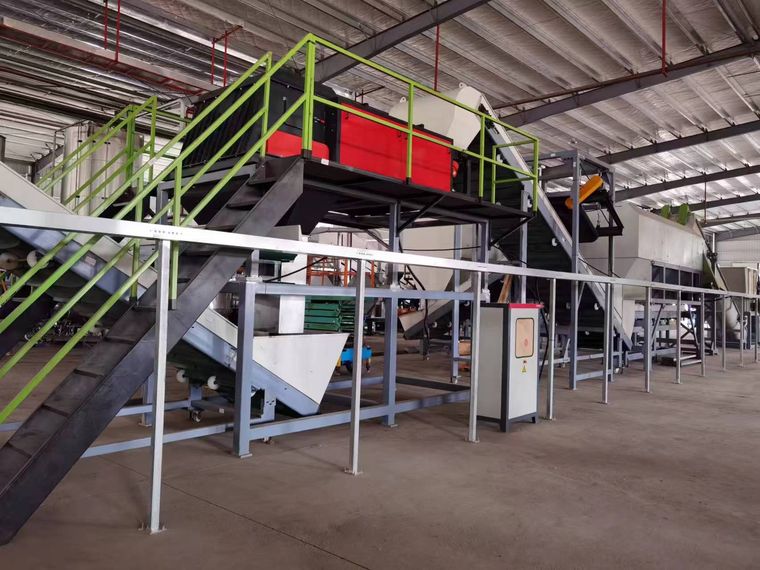
- Feeding and bale breaking. A chain-plate conveyor and a four-shaft bale breaker open the bales. Loose bottles can skip the bale breaker.
- Dry pre-cleaning. A magnetic separator and a trommel screen (Ø2000 × 8000 mm, 40 mm holes) remove stones, dust, loose caps and small metal before the bottles get wet.
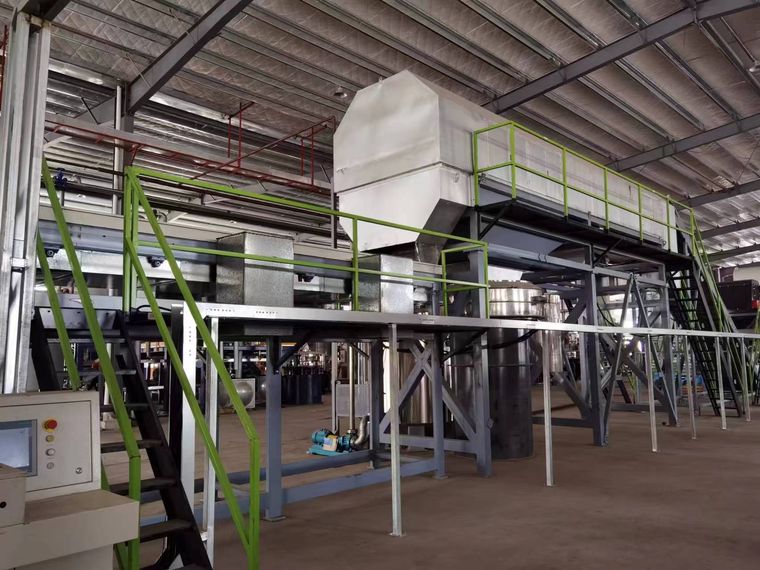
- Pre-wash and sorting. A drum pre-washer, manual sorting platforms and a 10 m³ buffer silo that decouples sorting from washing.
- Wet crushing. In the 4,000 kg/h reference line, three crushers run in parallel, so one can be serviced while the others keep running.
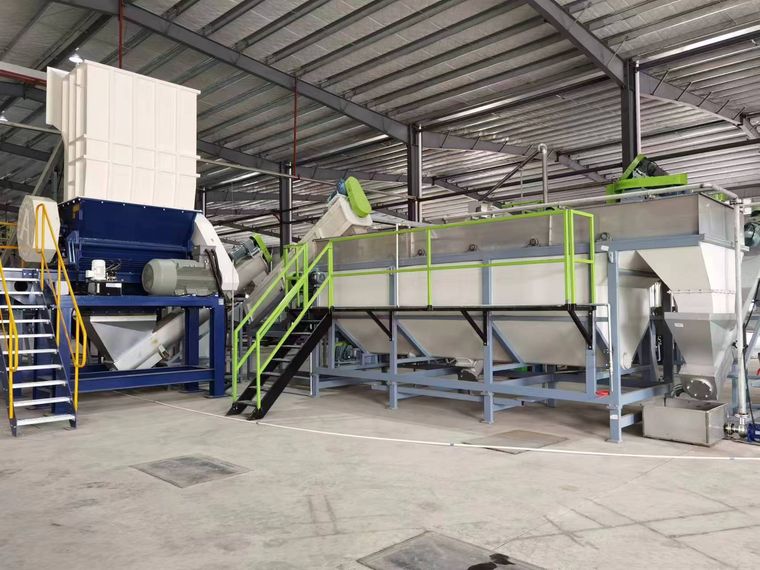
- Cold friction washing removes loose dirt.
- Hot wash, two stages. About 6 m³ each, steam-heated to 70–80 °C with automatic caustic dosing, each followed by a 55 kW high-speed friction washer. This removes glue, oil, residue and paper labels, and the odour that comes with them.
- Rinsing cascade. Four rinsing tanks with friction washers. PE and PP float; PET, PVC, metal and stones sink.
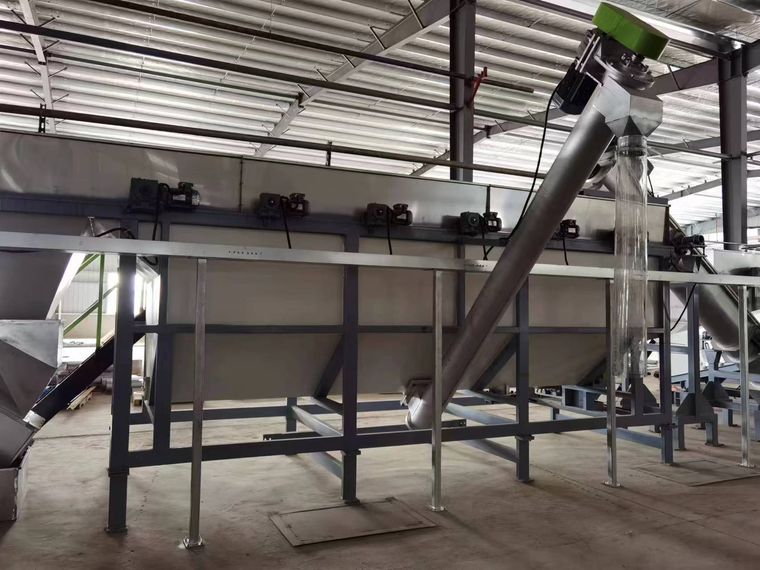
- Dewatering and drying. A horizontal dewatering machine removes the caustic water, a centrifugal dryer brings moisture to about 2 %, and pneumatic drying brings it to about 1 %.
- Label separation. Two zig-zag separators with four suction points take out film labels and dust.
Three things that change the configuration
- Labels. PP and BOPP film labels float exactly like the flakes, so rinsing tanks cannot remove them. Keep the pneumatic label separation. Paper labels are mainly removed by the hot wash and friction.
- Residue. Milk, detergent and oil bottles need the hot wash, preferably two stages. Oil bottles also need higher caustic concentration and more rinsing. Agrochemical containers must be triple-rinsed first, and local hazardous-waste rules apply.
- PE and PP together. Both float, so water cannot separate them. If your customers need pure HDPE, an NIR material sorter on whole bottles or flakes is needed. PET bottles need a PET washing line; they sink and run with different settings.
Bulk density depends on the source
Bulk density sets the size of silos, screws and pneumatic conveying. Thin-walled parts give light flakes; thick-walled parts give heavy ones.
| Washed flakes from | Bulk density (kg/m³) |
|---|---|
| HDPE coconut-water bottles | 230–280 |
| HDPE detergent and cosmetics bottles | 280–360 |
| HDPE large blue drums | 420–500 |
| HDPE caps | 280–360 |
| PP recycled flakes | 240–300 |
| PP fruit crates | 270–350 |
| PP food containers | 90–150 |
| PP plastic boxes | 400–480 |
| PP washing machine drums | 380–450 |
Very light flakes, such as food containers, take two to three times the volume of normal bottle flakes at the same kg/h, so crushers, friction washers and conveying may limit output. Thick, large parts such as drums, boxes and washing machine drums may need pre-shredding. In both cases the output is recalculated for your material before quoting.
Reference line data
| Item | Value |
|---|---|
| Raw material | Post-consumer HDPE/PP bottles (milk, detergent, shampoo), baled or loose |
| Flakes | 10–14 mm |
| Moisture | about 1 % after pneumatic drying and label separation |
| Bulk density | about 300 kg/m³ (0.3 g/cm³) for milk and detergent bottle flakes; depends on the source |
| Hot wash | 2 stages, about 6 m³ each, 70–80 °C, automatic caustic dosing |
| Installed power | about 1,000 kW class at 4,000 kg/h, final figure by configuration |
| Water | 15 t/h, 0.4 MPa, closed-loop filtration with make-up |
| Steam (hot wash) | 1,000 kg/h, 170 °C, 0.7 MPa; steam boiler optional |
| Workshop (minimum) | 90 m × 20 m × 6 m, with overhead crane |
| Operators | 7–9 per shift |
| Optional equipment | Steam boiler, colour sorter, automatic bagging |
Lines from 500 kg/h are configured per project. Above about 5,000 kg/h, two parallel lines are usually the better choice: investment can be phased, and one line keeps running while the other is serviced.
How to compare quotations
- Is there dry pre-cleaning before the crushers, or do stones go straight into the knives?
- How large are the hot washers, and is caustic dosing automatic?
- How many rinsing stages follow the hot wash?
- How are PP film labels removed, and what is the final moisture?
- Does the whole line stop when one crusher is serviced?
- Are the parts in contact with caustic water made of stainless steel?
The cheapest lines usually save on exactly these points, and they decide what your flakes can sell for.
What to send for a quotation
- Output in kg/h of finished flakes
- Bottle type: milk, detergent, oil, mixed; baled or loose; label type
- Who buys the flakes, or what you will make from them
- Whether you already have steam
- Voltage and frequency at your plant
To pelletize the washed flakes, read the HDPE bottle recycling guide.
See also: PET bottle washing line · PE/PP bottle washing line specifications
Tell us your material and target output
Send the material type, output in kg/h and final product. We reply within 24 hours with a configuration and price range.
- WhatsApp: +86 130 1820 8126
- Email: [email protected]
- Email: [email protected]