Rigid plastic looks simpler than film: it does not wrap around shafts and it feeds well. But "rigid" covers very different streams, from clean injection regrind to blue chemical drums, fruit crates and mixed ABS/PC housings. Four questions decide the line: how big and thick are the parts, how dirty are they, which polymers are mixed together, and what will the pellets be used for.
Step 1: size reduction depends on the part
| Material | Typical first step |
|---|---|
| Small hollow parts, bottles, thin-walled packaging | Straight into a crusher (wet crushing if the line washes) |
| Blue drums (bombonas), crates, pallets, washing machine drums | Pre-shredding, then crushing |
| Lumps, purgings, pipes, profiles | Single-shaft shredder, then crushing |
| Clean production regrind already in flakes | No size reduction needed |
Two shredder types are available: the XD-E double-shaft shredder (500–1,500 kg/h) tears bulky parts at low speed and high torque; the single-shaft shredder (models 600 to 1500, 200–1,500 kg/h) is the usual choice for lumps, purgings and thick profiles. Some materials work only on one of the two, so the choice is made from a photo of your material.
Step 2: wash only what needs washing
- Clean post-industrial regrind (rejects, runners, sprues of one polymer) usually goes straight to pelletizing.
- Post-consumer rigid parts need a washing line: dry pre-cleaning to take out stones, sand and metal, wet crushing, friction washing, and a hot wash when there is oil, detergent, food residue or glue. The PE/PP bottle washing line guide explains each stage.
- Chemical and agrochemical containers must be triple-rinsed before they reach the line, and local hazardous-waste rules apply.
Water also sorts by density: PE and PP float, while ABS, PC, PET, PVC, metal and stones sink. A sink-float tank therefore separates polyolefins from ABS and PC, but it cannot separate PE from PP; that needs an NIR sorter.
Bulk density: why light flakes limit output
The same kg/h of light flakes takes more volume in the crusher, conveyors and extruder feed. Thick parts give heavy flakes; thin-walled parts give light ones.
| Washed flakes from | Bulk density (kg/m³) |
|---|---|
| HDPE large blue drums | 420–500 |
| PP plastic boxes | 400–480 |
| PP washing machine drums | 380–450 |
| PP fruit crates | 270–350 |
| HDPE caps | 280–360 |
| PP food containers | 90–150 |
Very light flakes may need forced feeding into the extruder. The output is always recalculated for your material before quoting.
Step 3: pelletizing on an SJ line, single-stage or two-stage
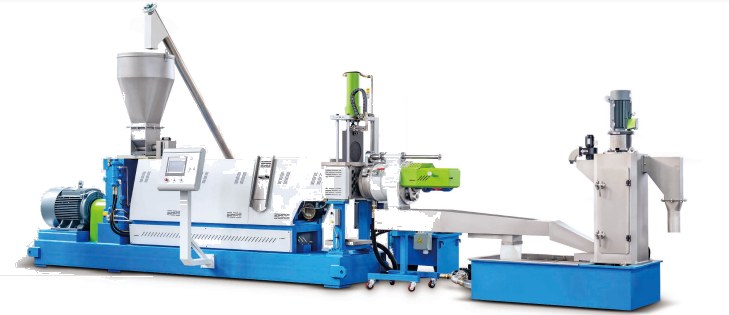
Plastic recycling machines by Jiangsu PURUI include SJ rigid pelletizing lines for buckets, small hollow bottles, milk bottles, crushed rigid PE and PP, and PP, PC and ABS regrind, from 250 to 1,500 kg/h.
| Model | Screw diameter (mm) | Output (kg/h) |
|---|---|---|
| SJ100 | 100 | 250–350 |
| SJ120 | 120 | 300–400 |
| SJ140 | 140 | 500–600 |
| SJ150 | 150 | 600–800 |
| SJ160 | 160 | 800–1,000 |
| SJ180 | 180 | 900–1,200 |
| SJ200 | 200 | 1,000–1,500 |
On a two-stage line, the first extruder melts the flakes and removes coarse contamination; after vacuum degassing, the second filters more finely and pelletizes. Each screen blocks less often and the fine screen is protected. A single-stage line is simpler and fits cleaner, single-polymer material. Where the material is heavily soiled, or the output is from about 800 kg/h upwards, a laser filter is added. The configuration is confirmed for your material. Photos of the material are enough for a first configuration.
ABS, PC and PP: keep polymers apart
- Do not mix polymers if you want to sell the pellets as a grade. PP, ABS and PC are not compatible in the melt, and mixed pellets sell only as low-value filler material.
- ABS and PC absorb moisture. Like PET, they need dry flakes before extrusion, otherwise the pellets lose properties and show bubbles.
- To add value, recycled flakes can be modified on a single-screw + twin-screw line, for example the SJ110 + TSSK75 line (600 kg/h), which adds fillers, glass fibre or colour after the first stage.
What to send for a quotation
- Photos of the parts as they arrive (bales, loose, or regrind)
- Polymers present, and whether they are mixed
- How dirty they are: oil, chemicals, labels, food residue
- Target output in kg/h and what the pellets will be used for
- Voltage and frequency at your plant
The line selector gives a first configuration in two minutes.
See also: ML or SJ pelletizing line? · HDPE bottle recycling · SJ rigid pelletizing lines
Tell us your material and target output
Every line is specified to your material, output and plant conditions. These are custom machines, not stock items. Send the material, target kg/h and plant power. We reply within 24 hours with a configuration and a quotation.
- WhatsApp: +86 130 1820 8126
- Email: [email protected]