The first question in any recycling pelletizing project is how the material will get into the screw. Light, bulky film and dense, free-flowing flakes behave completely differently in a feed throat. That difference decides whether you need an ML or an SJ line.
Film feeds badly, flakes feed easily
Film, raffia and non-woven material have a very low bulk density. Poured into a normal hopper, they bridge and the screw starves. Rigid flakes and regrind are dense and flow on their own, so a standard hopper feed works.
ML series: for clean film scrap and fibrous material
The Jiangsu PURUI ML series is built for clean, dry BOPP, PP, HDPE, LDPE, LLDPE, PS, PLA and PET film scrap, non-woven fabric, woven bags and fibre, fed directly without washing.
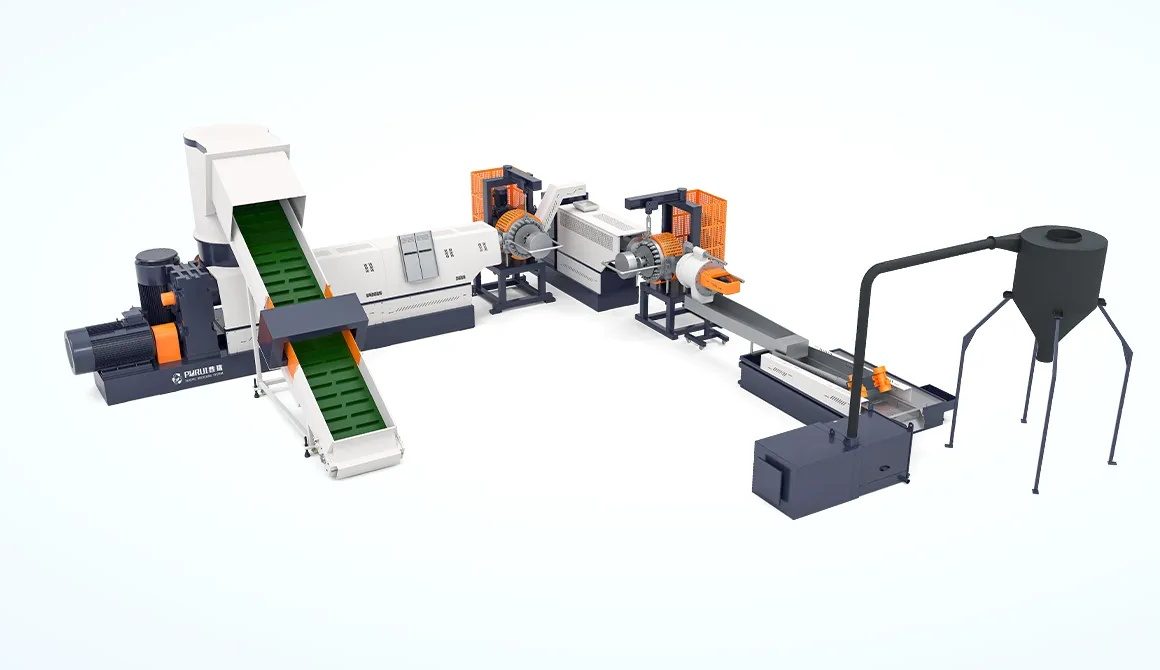
| Model | Screw diameter | PP (kg/h) | HDPE (kg/h) | LDPE (kg/h) |
|---|---|---|---|---|
| ML75 | 75 mm | 100 | 120 | 150 |
| ML85 | 85 mm | 120 | 150 | 180 |
| ML100 | 100 mm | 200 | 300 | 400 |
| ML130 | 130 mm | 400 | 500 | 600 |
| ML160 | 160 mm | 600 | 700 | 1,000 |
| ML180 | 180 mm | 800 | 1,000 | 1,200 |
SJ series: for rigid flakes and regrind
The SJ series is a single-screw recycling extruder for HDPE bottle flakes, crushed rigid PE and PP, PP, PC and ABS regrind, and washed film flakes.
| Model | Screw diameter | Output |
|---|---|---|
| SJ100 | 100 mm | 250 – 350 kg/h |
| SJ120 | 120 mm | 300 – 400 kg/h |
| SJ140 | 140 mm | 500 – 600 kg/h |
| SJ150 | 150 mm | 600 – 800 kg/h |
| SJ160 | 160 mm | 800 – 1,000 kg/h |
| SJ180 | 180 mm | 900 – 1,200 kg/h |
| SJ200 | 200 mm | 1,000 – 1,500 kg/h |
All SJ models run at 10 to 150 r/min with an L/D of 18 to 42.
See a real line: food-grade HDPE milk bottle flakes, SJ110 + TSSK75 two-stage line, with photos and video.
Washed film goes to an SJ two-stage line
After a washing line, film flakes are not pelletized on an ML line. They go to an SJ two-stage line: the first extruder melts and degasses, and the second filters again and pelletizes. For large outputs, a laser filter is added. See the agricultural film recycling guide.
When you need two stages
Heavily printed film, film with residual moisture and material with volatile contamination often need a two-stage line: a first extruder melts and degasses, and a second extruder filters again and pelletizes. Ask for a two-stage configuration if your pellets show bubbles, odor or black specks on a single-stage line.
A quick way to decide
- Clean, unwashed film scrap, raffia, non-woven: ML series
- Washed film flakes from a washing line: SJ two-stage line, with a laser filter for large outputs
- HDPE bottle flakes, crushed rigid PE and PP, PC or ABS regrind: SJ series
- Heavily printed or moist film: ask for a two-stage configuration
- Mixed film and rigid material: send photos of both; the share of each decides the line
Output always depends on the material, its moisture and the motor configuration. Photos of the material are enough when requesting a quotation. Full tables are on the recycling machines page.
See also: How to choose a screen changer for recycled PE and PP.
Tell us your material and target output
Every line is specified to your material, output and plant conditions. These are custom machines, not stock items. Send the material, target kg/h and plant power. We reply within 24 hours with a configuration and a quotation.
- WhatsApp: +86 130 1820 8126
- Email: [email protected]