Agricultural film, greenhouse film and mulch film come back from the field heavy with soil, sand, stones, plant residue and water. A line that works on clean factory scrap will not cope. This guide explains how a Jiangsu PURUI agricultural film line is built, from the shredder to the pellet, and what we need from you to size it.
Why agricultural film is hard to recycle
- Soil and sand. Sand wears blades, screws and screens. It has to come out early, before the crusher and long before the extruder.
- Long, tangled film. Whole film wraps around shafts and rotors, so it is shredded before anything else.
- Thin flakes hold water. After washing, light film flakes carry a lot of water that the pelletizing line would otherwise have to boil off.
- Dirt left in the melt. Fine sand, wood and stones that survive washing end up on the screen of the extruder.
Front end: pre-shredding, crushing and trommel screening
A pre-shredder cuts the bales and rolls into pieces. A crusher reduces them further, and a trommel screen, a rotating drum, lets loose soil and sand fall out before the material goes into water.
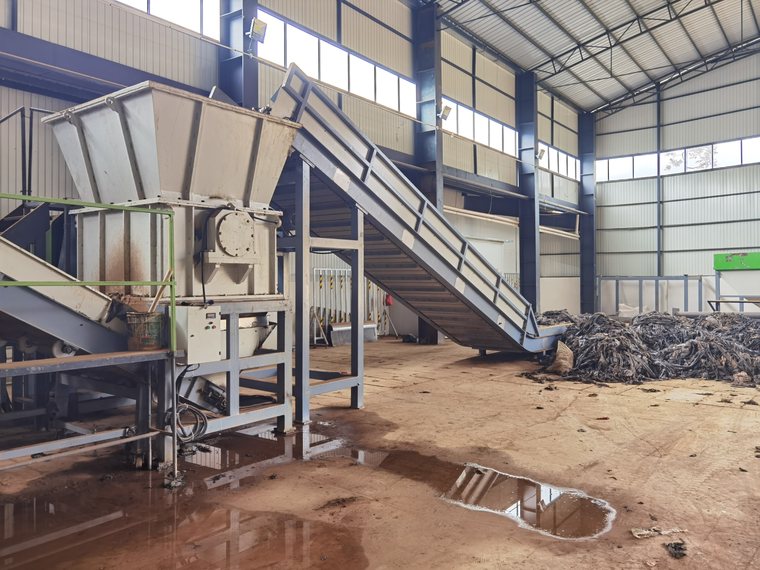
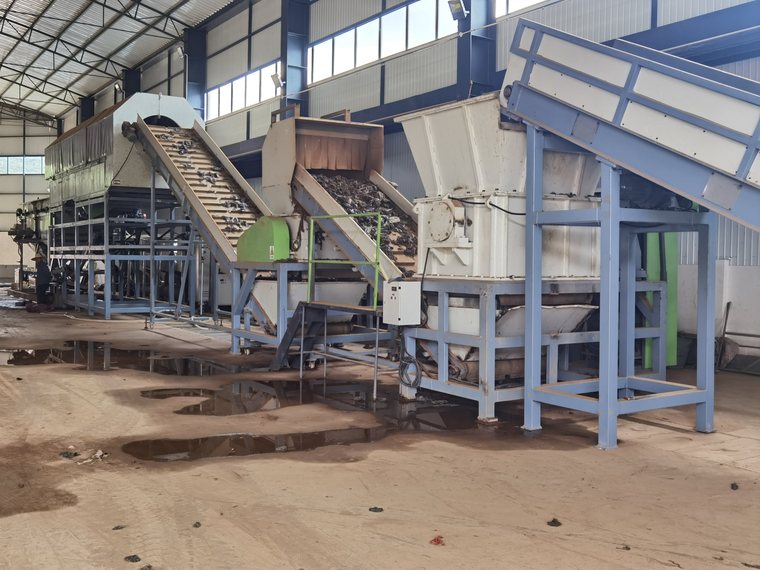
Washing: set up by how dirty your film is
There is no single standard sequence. The washing steps are chosen by the dirt level of your film: how much sand and soil, what other impurities, labels and so on. Lightly soiled film needs fewer stations; heavily soiled field film gets repeated pre-washing before the friction washer. A heavy-duty configuration looks like this:
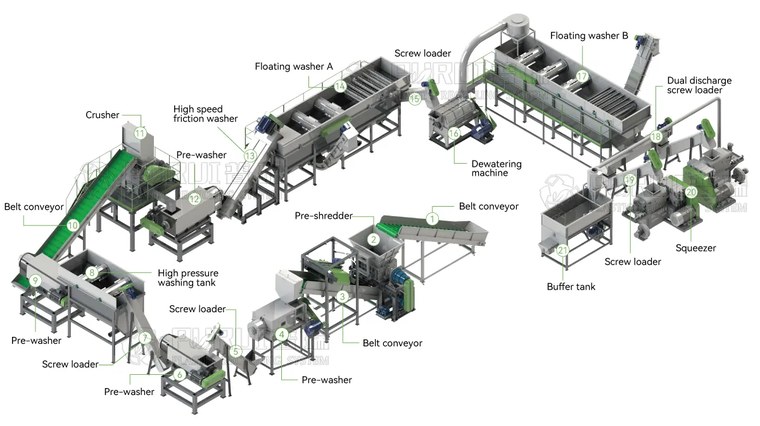
- Repeated pre-washing. Pre-washers and a high-pressure washing tank take out most of the soil and sand.
- Wet crushing. A crusher with water feed cuts the film into flakes and keeps the blades cool.
- High-speed friction washing. Scrubs the flake surface to release the remaining dirt.
- Floating separation. PE film floats while sand, stones and heavy plastics sink.
- Dewatering and squeeze drying. A dewatering machine removes most of the water, and a squeeze dryer brings moisture down to 1 to 3 %.
| Capacity | 500, 800, 1,000, 1,500 and 2,000 kg/h |
| Moisture after squeeze dryer | 1 – 3 % |
| Water consumption, standard line | 15 – 20 t/h |
| Recommended water treatment system | 25 m³/h |
Pelletizing: SJ two-stage line, laser filter for large outputs
Washed film flakes are not pelletized on an ML line. They go to an SJ two-stage line. The first extruder melts the flakes and degasses the residual moisture; the second extruder filters the melt again and pelletizes. Splitting the job this way gives fewer bubbles and cleaner pellets from field film.
For large outputs, a laser filter is added. It is a self-cleaning melt filter built for solid contamination such as wood, paper and stone: contamination is scraped off and discharged automatically, so the line does not stop for screen changes. Models and capacities are in the screen changer guide.
SJ output ranges from 250 – 350 kg/h (SJ100) to 1,000 – 1,500 kg/h (SJ200). The washing line and the pelletizing line are sized together, so neither waits for the other. Full tables are on the recycling machines page.
What to send for a quotation
- Photos of your film as it arrives: bales, rolls, loose material
- Type of film: greenhouse, mulch, silage, and whether it is LDPE, LLDPE or mixed
- An estimate of the dirt content and type: sand, soil, stones, plant residue
- Target output in kg/h and working hours per day
- What the pellets will be used for
- Available water, power and floor space
Plastic recycling machines by Jiangsu PURUI, manufacturing in Jiangsu since 2006. Contracts are signed directly with the manufacturer; Torqplas handles specification, material trials and project follow-up.
Try it: enter your film, dirt level and output in the line selector.
See also: How to choose a PP woven bag washing line · ML or SJ pelletizing line
Tell us your material and target output
Send the material type, output in kg/h and final product. We reply within 24 hours with a configuration and price range.
- WhatsApp: +86 130 1820 8126
- Email: [email protected]
- Email: [email protected]