Plain recycled pellets compete on price with every other recycler. Modified recycled pellets, such as talc-filled PP, glass-fibre PP or coloured compounds, are sold to a specification: to injection moulders of appliance, automotive and household parts. A single-screw + twin-screw line does both jobs in one pass. The first stage recycles the flakes, the second stage turns the clean melt into a compound.
Why compound recycled material now
Buyers of compounds increasingly ask for recycled content. In the EU, the end-of-life vehicles regulation, formally adopted by the Council on 29 June 2026, requires new vehicles to contain at least 15 % recycled plastic six years after it enters into force, rising to 25 % after ten years. Talc-filled and glass-fibre PP are typical car-part materials, so a recycler who can deliver them as a stable grade sells into a market that plain regrind cannot reach.
How the two-in-one line works
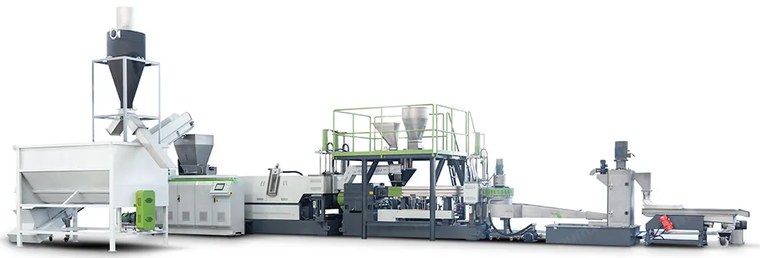
- Single-screw first stage. Melts the washed flakes or regrind, removes moisture and volatiles through vacuum degassing, and filters out contamination in a screen changer.
- Melt transfer. The filtered melt goes straight into the twin-screw extruder, without cooling and pelletizing in between.
- Twin-screw second stage. Fillers, glass fibre, pigments or additives are fed in and dispersed in the melt, then vented again.
- Pelletizing. Strand, water-ring or air-cooled die-face cutting, chosen by the compound.
Compared with pelletizing the recycled material first and compounding it later on a second line, the material is melted once instead of twice. That means one heat history less for the polymer, less energy, and no intermediate handling.
| SJ110 + TSSK75 | |
|---|---|
| First stage | Single-screw extruder, screw diameter 110 mm, motor 132 kW |
| Second stage | Twin-screw extruder, screw diameter 75 mm |
| Line output | 600 kg/h |
| Power configuration | Set according to the material and formula |
Where each additive goes in
| Additive | Where it is fed | Why |
|---|---|---|
| Colour masterbatch, stabilisers | With the flakes, into the first stage (or an additive feeder at the main feed) | Pellets of masterbatch melt and mix like the base polymer |
| Talc, calcium carbonate | Twin-screw side feeder, into the molten polymer | Fine powder carries a lot of air; fed at the main hopper it fills the screws with powder instead of melt |
| Glass fibre | Twin-screw side feeder, downstream | Fibres added to the melt break less, and fibre length gives the stiffness |
VJJ twin-screw extruders can take side feeders on both sides of the barrel. Two feeders give more feeding capacity for high filler loadings, or let two different additives go in at the same point. Gravimetric (loss-in-weight) feeders keep each ratio constant, which keeps torque and pellet quality stable.
How much talc or glass fibre?
There is no fixed figure. The filler content is set by the grade you sell and by your customer's moulding process. Compounds are usually named by it, for example PP-T20 for 20 % talc or PP-GF30 for 30 % glass fibre. On the line, the feeders are set as a share of the line output, so the same line can run several grades.
What does change with the loading is the load on the twin screw. A highly filled melt is stiff, and the extruder reaches its torque limit before its maximum speed. VJJ extruders come in two torque classes, 11.3 Nm/cm³ (standard) and 14 Nm/cm³ (high-torque); at the same diameter and speed, 14 Nm/cm³ gives about a quarter more torque, which means more output or a higher loading. The specific torque guide explains this in detail.
Clean melt first: the first stage decides the compound
- Filter before the additives go in. The screen changer on the first stage removes paper, aluminium and other contamination while the melt is still unfilled. Talc and glass fibre are costly; you do not want to add them to dirt.
- Dry and degas. Moisture and volatiles left in the melt show up as bubbles and weak spots in moulded parts. Degassing on both stages removes them.
- Keep polymers apart. A talc-filled PP grade starts from PP flakes. Mixed PP/PE or PP/ABS flakes give a compound with unpredictable properties.
This line configuration has already run a demanding job: food-grade HDPE milk bottle flakes in China (March 2026), where, as reported by Jiangsu PURUI, the pellets passed the customer's odour test, showed no black spots and replaced 30 % of the customer's virgin HDPE. See the case study.
Pelletizing filled and reinforced compounds
Highly filled strands are brittle, so water-ring or air-cooled die-face cutting is common for talc and calcium carbonate compounds; strand pelletizing works at lower loadings and for glass-fibre grades. The pelletizing guide compares the three systems.
One line or two?
- Single screw + twin screw in one line when you recycle your own flakes and always sell a compound.
- A recycling line plus a separate VJJ extruder when you also sell plain recycled pellets, buy in recycled pellets from others, or compound virgin resin too. See the VJJ twin-screw extruders.
What to send for a quotation
- Photos of the flakes or regrind, the polymer, and where it comes from
- The compound you want to sell: filler or fibre type and content, colour, other additives
- Target output in kg/h
- Pelletizing preference, and the voltage and frequency at your plant
The line selector gives a first configuration in two minutes.
See also: SJ110 + TSSK75 line · Rigid plastic recycling · ML or SJ pelletizing line? · Filler masterbatch and specific torque
Tell us your material and target output
Every line is specified to your material, output and plant conditions. These are custom machines, not stock items. Send the material, target kg/h and plant power. We reply within 24 hours with a configuration and a quotation.
- WhatsApp: +86 130 1820 8126
- Email: [email protected]