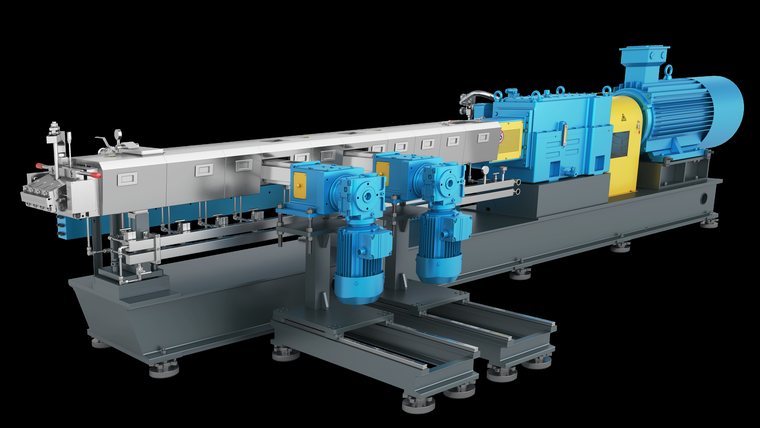
Polycarbonate is one of the least forgiving materials to compound. The melt is stiff, the processing temperature is high, and clear grades show every defect: one degraded particle becomes a black speck, and a little too much heat history turns the pellets yellow. This guide explains where those problems come from and how VJJ PC-series twin-screw extruders are built to deal with them.
Why PC is hard to compound
- High melt viscosity. PC needs a lot of torque to convey and mix. On many lines the motor reaches its torque limit long before the screws reach top speed.
- High temperature, narrow window. PC is processed hot, and extra time at temperature degrades it.
- Moisture sensitivity. Wet PC hydrolyses in the melt and loses molecular weight, so the resin has to be dried before it reaches the extruder.
- Clear grades show everything. In a transparent pellet, specks and colour shifts that would hide in a black compound are rejected by the customer.
The five problems PC compounders bring to us
- Black specks: degraded material released from dead zones and from the barrel wall.
- Yellowing: too much heat history or local overheating.
- Difficult cleaning: old material keeps coming out after a product change.
- High losses: off-spec material at start-up, shutdown and changeover.
- Property loss after compounding: the polymer chain breaks down in the extruder, so the MFI rises and the impact strength drops.
1. High torque: small machine, high output
Because PC is torque-limited, torque decides output. The VJJ PC series concentrates on torque at a compact screw diameter. The drive shafts are torsion-tested to failure, so the rating has margin behind it.
| Model | Output | Specific torque |
|---|---|---|
| KTSM⁺ PC36 | 600 kg/h or more | 11 – 14 Nm/cm³ |
| KTSM⁺ PC42 | 1,000 kg/h or more | 11 – 14 Nm/cm³ |
A smaller machine for the same output means less investment and floor space. It also means less melt inside the extruder at any moment, so each particle spends less time at temperature. For PC, that shorter heat history matters as much as the output itself. More on torque in the guide to specific torque and filler masterbatch.
2. Tight screw clearances
The PC series runs tighter clearances than the standard VJJ series. Clearance affects several things at once:
- Leakage flow: less melt slips back over the flights.
- Self-cleaning: less material stays on the barrel wall and in the screw roots.
- Residence time: a shorter, more even residence time, so fewer particles overstay and degrade.
- Machining and assembly precision: tight clearances only work when barrels and screw elements are machined and assembled accurately.
There is a trade-off. Shear rate rises as the gap closes (γ = π·D·n / h, where h is the gap), so the clearance is matched with screw configuration and speed for each PC grade rather than simply made as small as possible.
3. Barrel temperature control
Each barrel section has heating and cooling channels laid out around the melt channel, so the temperature responds quickly and stays even along the barrel. For PC, avoiding local hot spots is one of the simplest ways to limit yellowing.
4. Industrial PC control and remote monitoring
Here “PC” means industrial computer. The control system links the PC controller, temperature controllers and drives to a cloud server, so process data can be viewed from a computer or phone and connected to MES, ERP and SCADA systems. For plants running clear grades, a full process record makes it much easier to trace where a batch of specks came from.
Problem, cause and what helps
| Problem | Usual cause | What helps |
|---|---|---|
| Black specks | Material degrading in dead zones and on the barrel wall | Tight clearances, self-cleaning screws, melt filtration |
| Yellowing | Long heat history, local overheating | Compact high-torque machine, even barrel temperature |
| Difficult cleaning | Material held up in the screws and barrel | Self-cleaning geometry, tight clearances |
| High losses | Long purging at start-up and changeover | Smaller melt volume, faster clean-out |
| Property loss | Chain breakdown from heat, shear and moisture | Dry resin, shorter residence time, matched screw design |
What to send for a quotation
- PC grade and MFI, and whether the product is clear, coloured, glass-filled, flame-retardant or an alloy such as PC/ABS
- Target output in kg/h
- Quality targets your customers check, such as speck count, colour or MFI change
- Pelletizing method you prefer (see how to choose a pelletizing system)
- Your current line and the problems you see on it
See all VJJ specifications on the twin-screw extruders page.
Tell us your material and target output
Send the material type, output in kg/h and final product. We reply within 24 hours with a configuration and price range.
- WhatsApp: +86 130 1820 8126
- Email: [email protected]
- Email: [email protected]